Coaching through situational leadership
What coaching leadership means, how to apply S1 to S4 and why situational leadership is my go-to model. With an example from my own experience.

Lees dit artikel in het Nederlands
For me, coaching as a leader means helping people do their work with increasing independence and confidence. You make expectations clear, provide help where it is needed and create room for people to make their own decisions. How you approach that depends on both the person and the task.
That is why situational leadership is my go-to model. It helps me choose how much direction and support to provide. Someone starting out in SEO needs different guidance from an experienced specialist who wants to discuss a difficult decision. The principle sounds straightforward. Applying it requires you to keep adjusting your own approach.
What coaching as a leader involves
You need to understand what someone is trying to achieve and what they need to get there. They may lack knowledge. They may have the ability to do the work but feel uncertain about a decision. Asking questions, listening and reviewing the work together help you establish what is happening.
For me, coaching also involves clarity. What needs to happen? What does a good outcome look like? Which decisions can the person make independently? Without those agreements, freedom can feel ambiguous.
I want people to ask questions and be honest when they are struggling. My side of that involves making time and being available. Expecting openness only works if you make room for the response.
The Hersey and Blanchard model
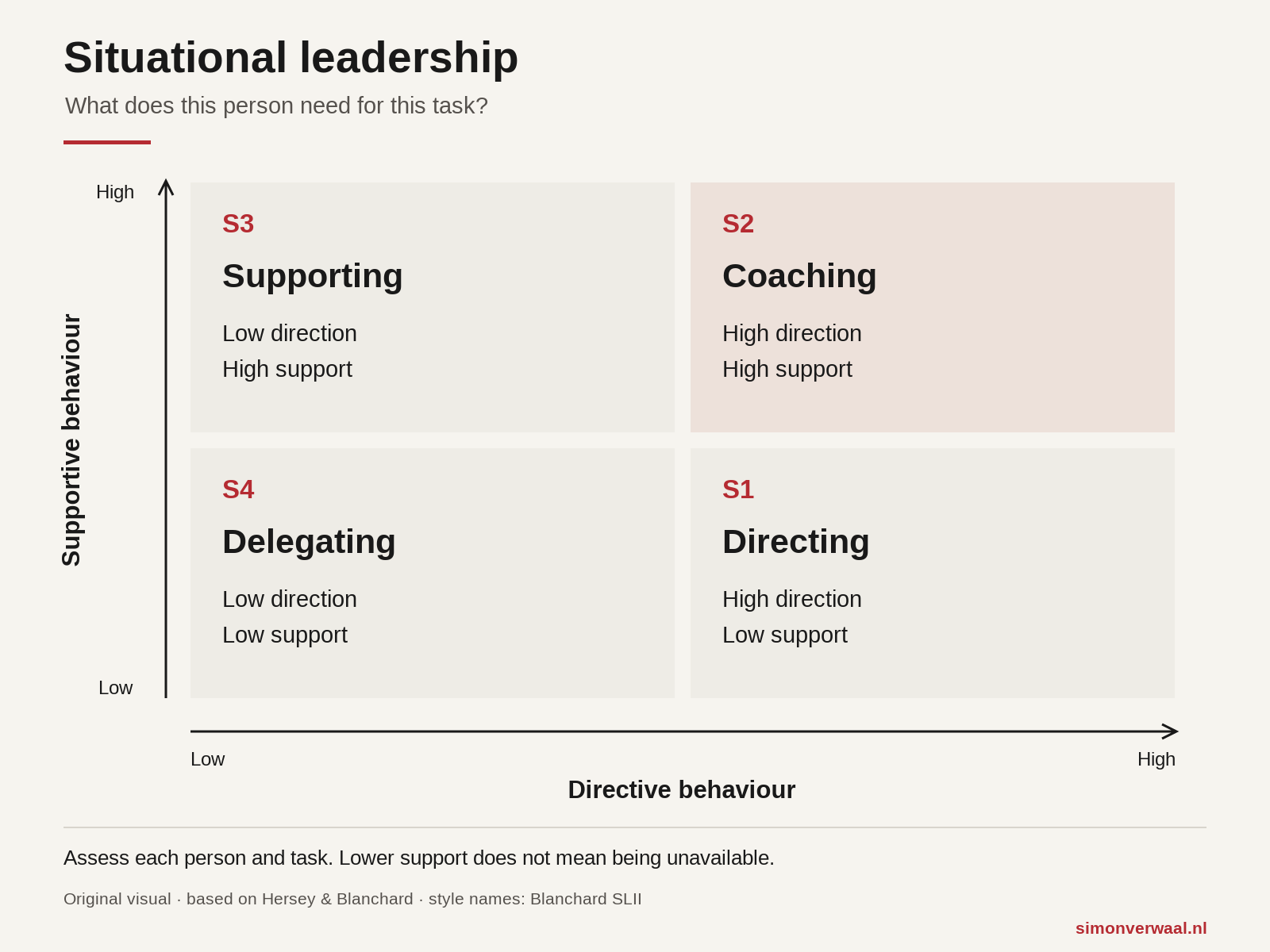
Situational leadership considers the guidance someone needs for a specific task. It combines two kinds of behaviour: direction, which provides structure for the work, and support, which involves listening, discussing and helping someone work through decisions. Different combinations produce four styles. Background on the model.
Below, I use the style names from Blanchard's later SLII framework. This builds on the original work by Hersey and Blanchard. The subsequent versions do not use identical terminology or development categories throughout.
| Style | What the guidance involves |
|---|---|
| S1: Directing | High direction and relatively low support. Explain specifically what needs doing and how. |
| S2: Coaching | High direction and high support. Provide explanations, discuss questions and help someone learn. |
| S3: Supporting | Low direction and high support. The person can do much of the work; you help with decisions, confidence and developing their own solutions. |
| S4: Delegating | Low direction and low support. The person takes more responsibility for decisions and execution. |
Lower support means less supportive behaviour is needed for the task. You remain available and agree on the expected outcome. Nor is anyone automatically S1 or S4 across everything they do. An experienced specialist may need more guidance on an unfamiliar task. More about applying SLII by task.
On this page, I use coaching as a leader in the broader sense of helping people develop. That can include a period of substantial instruction. Within the framework, S2 is the particular style called Coaching.
How I apply situational leadership
Start with the task and the intended outcome
First, define what you are discussing. 'Getting better at SEO' is too broad to choose useful guidance. Consider a technical review, for example. What should the person investigate, what should the review produce and which decisions can they make themselves?
This is an illustration of how to define the task. Once that is clear, you can work out what support would be useful.
Establish what someone can do and where they need help
Consider knowledge and experience alongside confidence and willingness to take on the task. Ask further questions. 'I am struggling' does not yet tell you whether someone needs an explanation, feels unsure about a decision or faces another obstacle.
I want to make that assessment with the colleague. Their job title alone does not give me enough information.
Agree on how you will provide guidance
If someone needs detailed explanation, provide it. Discuss what you will demonstrate, what they will take on and when you will next check in. If they can already handle the work, give them room to develop their own proposal.
Being available for questions matters to me. A scheduled check-in helps, but it should not become a reason to leave a question unanswered until then.
Adjust as the person develops
At the next conversation, review what is needed. Does the person understand the task better? Are they making decisions more independently? Your role can change accordingly. A new or more complex assignment may call for more guidance again.
The aim is to keep your approach aligned with their development. They should not have to keep adapting to your preferred way of managing.
Why this is my go-to model
I value clarity and personal attention. Situational leadership gives me a practical way to combine them. I can provide clear instructions and also ask how someone is doing. Later, I can give them more room while remaining available to discuss an issue.
Honesty matters to me. No bullshit about how well things are going when you are actually stuck. If something is not working, I want to know. If someone is open to learning and willing to put the effort in, we have a basis for progress.
I also want to understand personal obstacles. DISC profiles have helped me start conversations about differences in behaviour and communication. I use a profile as a prompt for questions. What a person tells me and demonstrates in practice carries more weight than a colour.
The model also makes me consider my own contribution. I have given a colleague too much direction when she needed more coaching and support. That experience reminds me to keep checking whether my guidance still fits. I explore the lesson further in five leadership mistakes.
What One Minute Manager adds
The practical ideas in the One Minute Manager books connect with this approach. The New One Minute Manager centres on clear goals, specific praise and timely redirection. Ken Blanchard explains those principles here.
I value that attention during the learning process. Discuss expectations and recognise progress. Give feedback while it can still help, rather than waiting for a formal review. That fits the check-ins I consider important: staying involved while someone is developing.
An example from my work
A colleague joined me from another team with no SEO knowledge. We had three months to prepare him for his final contract extension.
I provided substantial direction and instruction. We scheduled regular check-ins and I made time for questions. I also wanted to understand any personal obstacles. My expectation was clear: we would be honest with each other. If something was not working, we could discuss it, provided he remained open to learning and willing to put the effort in.
He earned the contract extension. My guidance then shifted towards more coaching and support. As he developed, my role had to change too.
Today, he is one of the leading SEO specialists at a large online marketing agency. His effort brought him there. My contribution was to provide the guidance he needed at that point in his development.
Why I value this approach within an organisation
I want people to develop their expertise and take on more responsibility. That also makes a team less dependent on one experienced colleague who has to help with everything. It requires an investment in explanation and attention, followed by room for people to do the work themselves.
For me, the value of situational leadership lies in that ongoing adjustment. You help someone develop while continuing to learn how to support them better.
My experience during the Paris protests touches on the same attention to context: what do you notice automatically, and what do you discover by being present?