Agent or agency? You're asking the wrong question
An AI agent or an agency? Simon Verwaal on where agents excel, why human judgment still matters and how asking the right question makes the difference.
Prefer listening?
6 minutesEnglish male voice Michael · Kokoro
Synthetic voice, not Simon’s own voice.
Lees dit artikel in het Nederlands
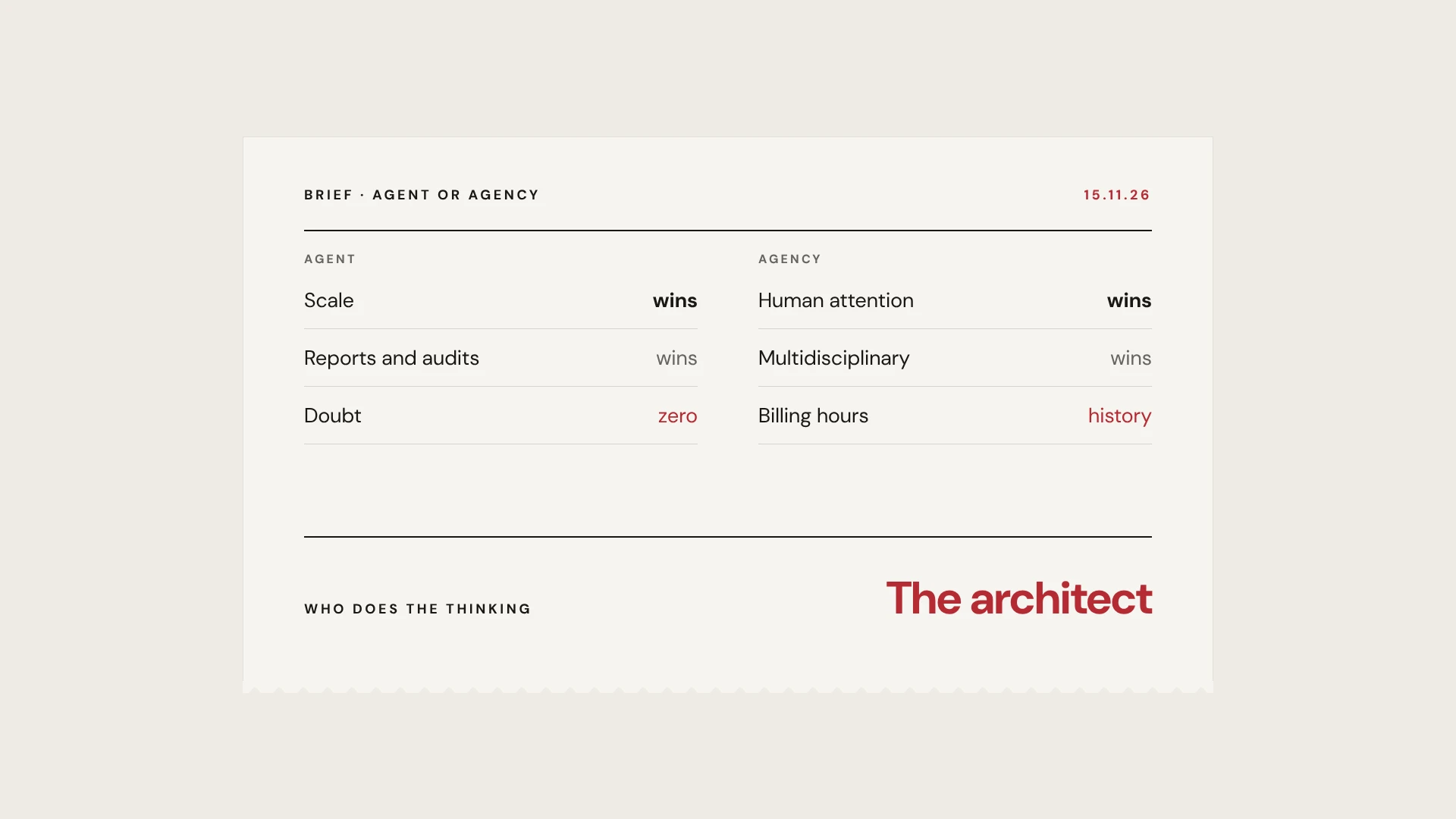
The verdict first: "agent or agency" is the wrong question. The real question is who does the thinking. And it's not the model.
I've spent more than eighteen years in this industry, on both sides of the table. As the client managing an agency, and as the agency that has to deliver. What I see now is business owners buried under AI promises. Every week, a new tool that "changes everything". The result? Nobody can tell what's good anymore, let alone what fits their business.
So everyone asks: why pay an agency when an agent can do it? Sometimes fair. Usually not.
An agent never doubts itself. That's the problem.
An agent wins on scale: repetitive work like reports, audits and first drafts of content. After a few days of building, an agent beats any agency on cost and speed there.
But an agent doesn't doubt. And doubt is exactly what you need.
In principle, you can build anything with agents and AI. Just not with one simple prompt, the way half of Instagram wants you to believe. "Type this and get a complete SEO strategy." No. You get text that looks like a strategy. Whoever sells that is selling a trick, not a solution. A good agent takes real thinking: what data goes in, what steps does it take, and who checks the result?
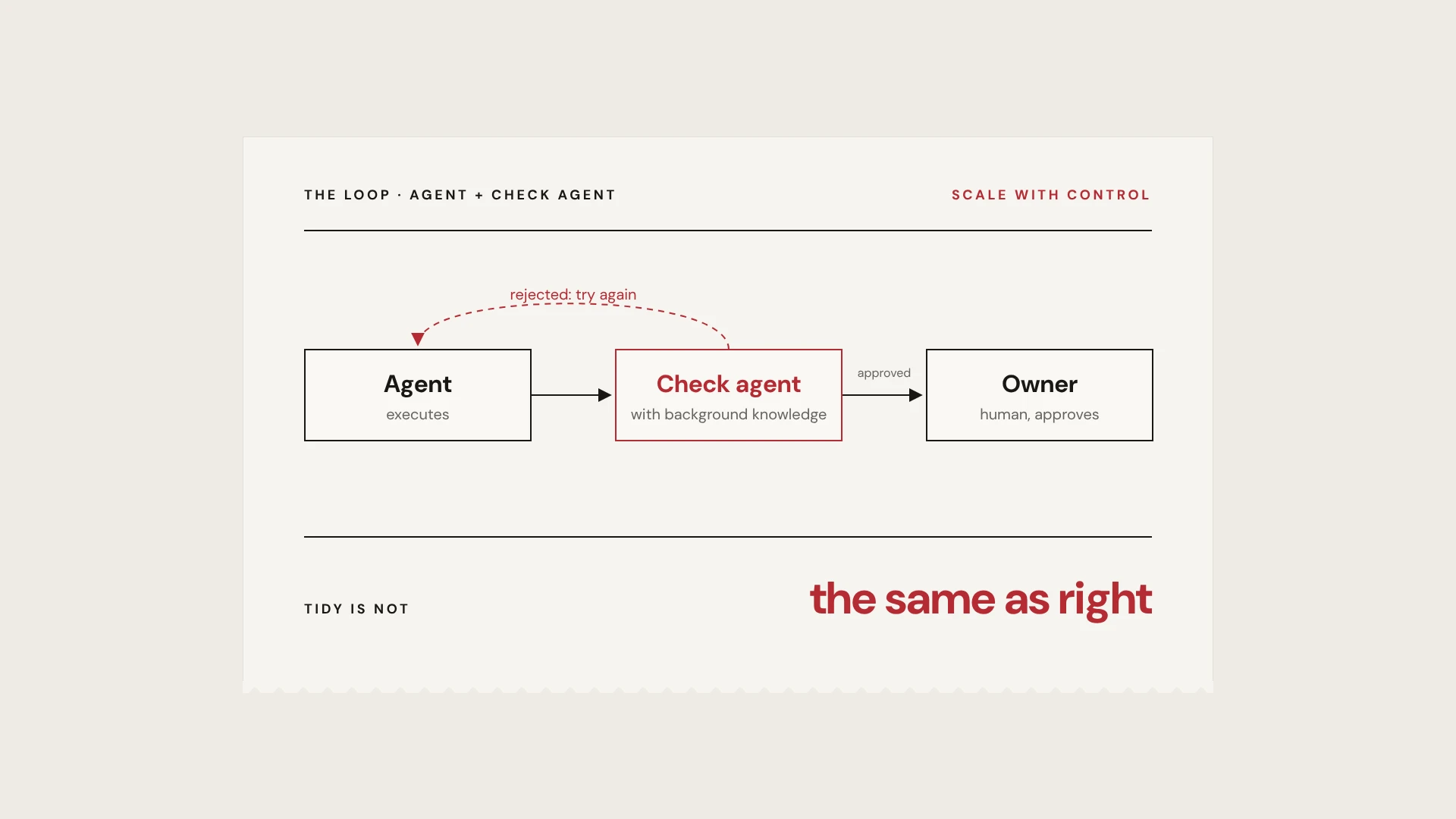
So a standalone agent isn't enough. Put it in a loop with a check agent that has real background knowledge of the subject. Otherwise it only checks whether the output looks tidy. Tidy is not the same as right.
Where it went wrong
I was troubleshooting an account with low organic visibility. Search Console showed a serious pile of pages marked "Crawled, currently not indexed" and "Discovered, currently not indexed" in the Page indexing report. I put an AI agent on it.
The agent came back with data and textbook fixes. Check the sitemaps, spot-check some internal links. Not wrong, just useless. It never asked what all those pages had in common. Does Google see the content as adding no value? Is there something technical underneath? Silence.
So I dug in myself. Every city, every date and every time slot had been built as its own regular slug. Once that slot had passed, the page ceased to exist. Google was fed a conveyor belt of pages with an expiry date. No wonder it gave up.
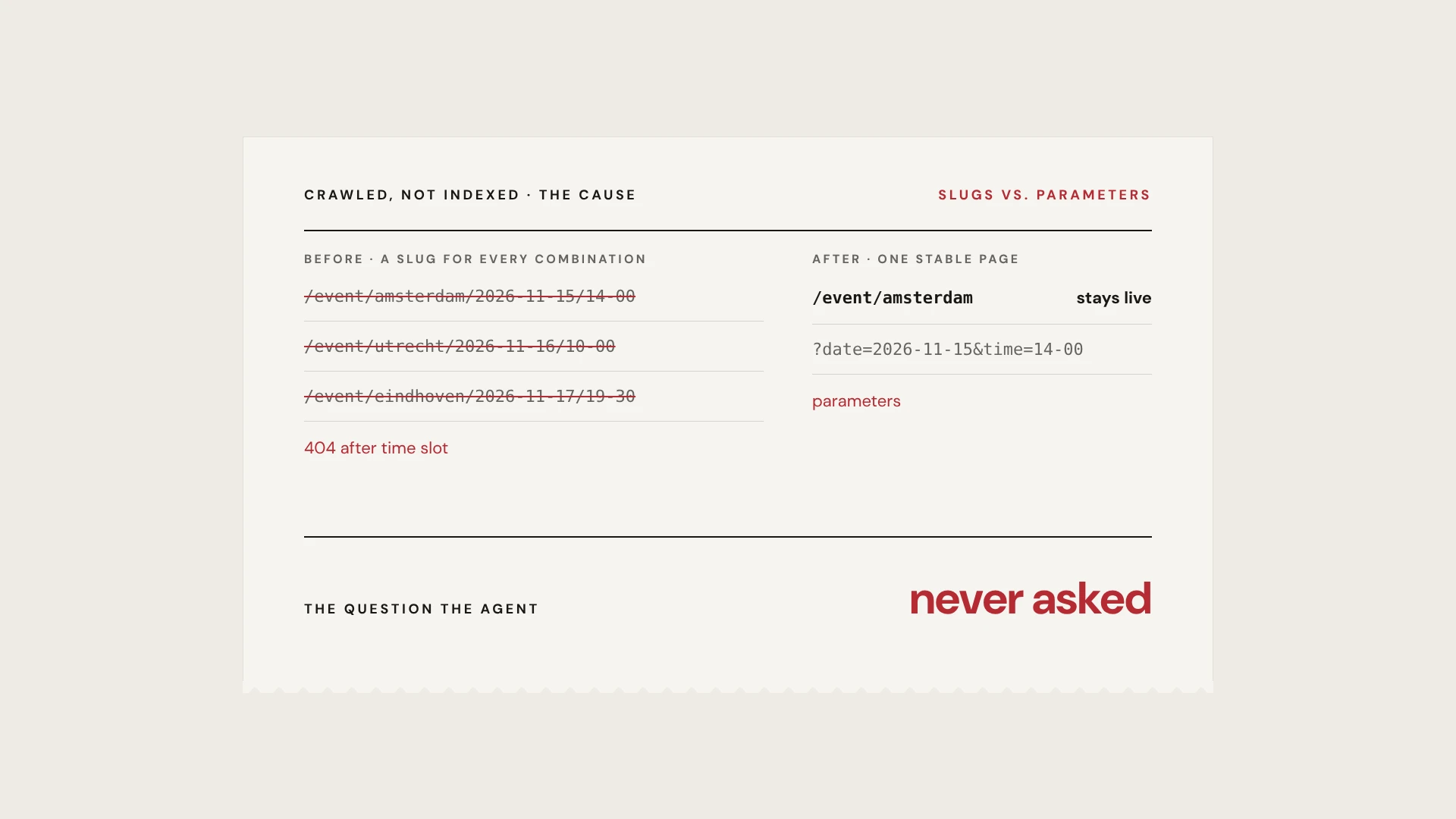
The fix wasn't even exciting. Those variables became parameters on a stable page, with content that actually matched search intent. But someone had to ask the right question first. That question wasn't in the model. It was in my head.
So when do you choose an agency?
When you value human attention more. And when you want to work across disciplines, because results never come from one channel or one trick. They come from the combination of surfaces: search engines, YouTube, social, LLMs.
To be fair, agents are getting better at that too. I used to bring the client team together and challenge everyone to come up with something good, fun and with follow-up potential that every discipline could hook into. SEO drove visibility through long-tail, SEA picked that up, and social brought in newsletter subscribers. Agents increasingly handle that alignment now. But someone still has to put the idea on the table that everyone hooks into.
Just choose an agency that works with AI and agents itself. If you're still paying for hours of manual work in 2026 that an agent does in minutes, you're not investing. You're sponsoring.
From the client side: make sure every account is in your name. Your data and your knowledge should stay with you.
We are the architects
Online marketers aren't being replaced by agents. We are their architects. We decide which questions get asked, which checks are built in and when something is good enough. Hand that over, and you're no longer a marketer. You're an operator of someone else's tool.
That takes three things. Being innovative, because last year's approach is already outdated. Thinking logically, because you build an agent on structure, not on hope. And above all, staying critical. The biggest problem in our industry isn't AI. It's going with the flow and never challenging the status quo.
Yannick Khayati put it well in a webinar: execution got cheap, judgment got expensive.
Agent or agency? Let an agent try first. If it can't, or you want more than execution, choose an agency that understands how those agents work. And whatever you choose, make sure someone is at the wheel who dares to ask whether this is even the right question. Because an agent does exactly what you ask. That's its strength, and its biggest weakness.