
Google didn't change the rules on AI content. It wrote down the bill.
Google now calls manual fact-checking of AI content critical, titles and structured data included. Why the real fix starts with your input data.
Prefer listening?
13 minutesEnglish male voice Michael · Kokoro
Synthetic voice, not Simon’s own voice.
Lees dit artikel in het Nederlands
The verdict
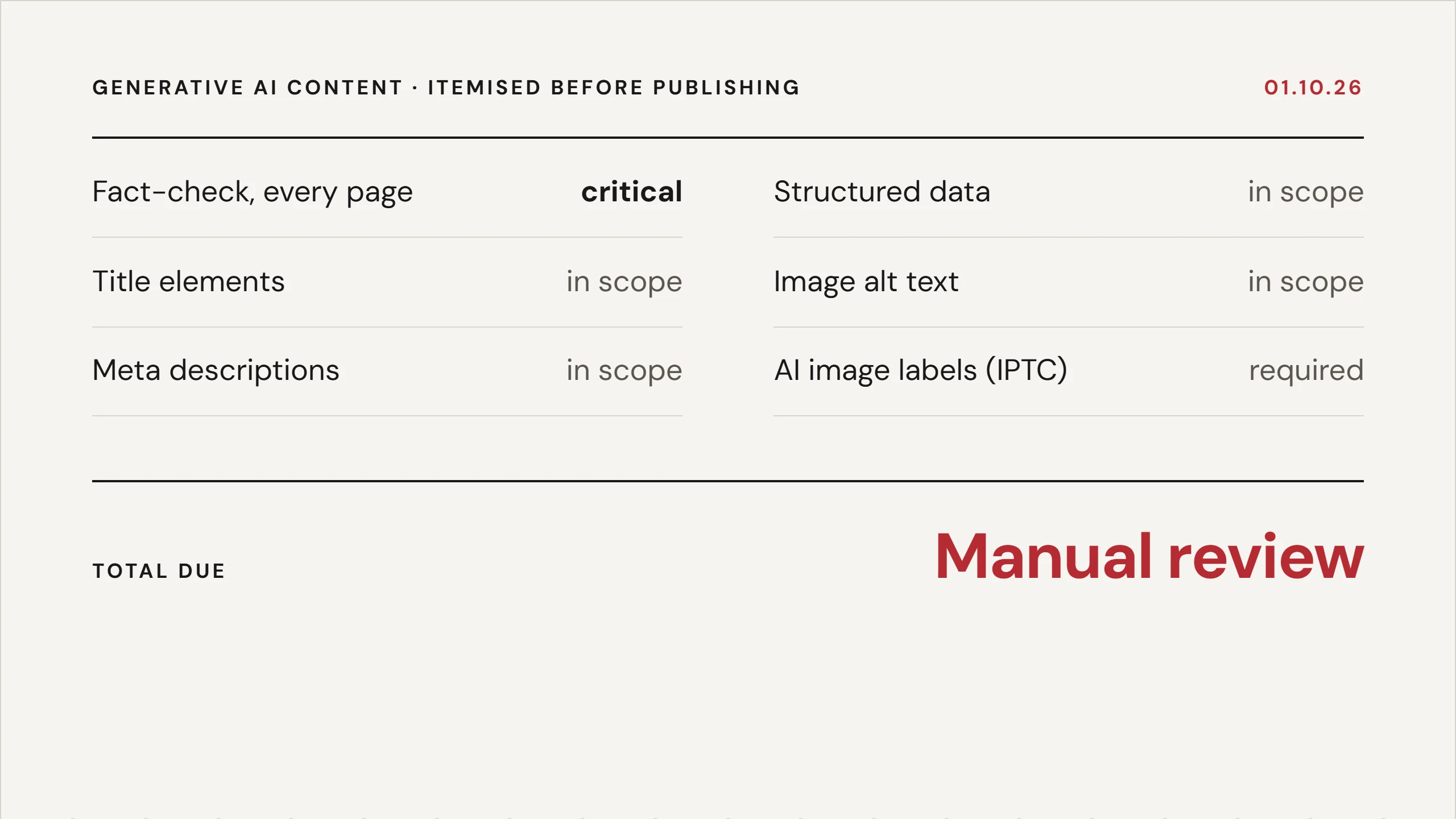
On 1 October 2026 Google added one sentence to its guidance on generative AI content: "It is critical to manually factcheck and review all AI-generated content for accuracy and trustworthiness before publishing." Critical. Google rarely uses that word in its documentation, so it's worth taking seriously.
I agree with every word of it. I also think most teams will read it the wrong way.
They'll read it as "add a review step at the end". Hire an editor, run a checklist, ship. That treats hallucinations as a typo problem. They aren't. A model that invents a fact is a model that wasn't given the fact. Fact-checking at the end is a patch on a data problem at the start, and patches don't scale. Data does.
Edward Sturm covered the update in The Edward Show E1187, and his core point is the right one: AI content itself isn't the problem. Unreviewed AI content is. I'd push it one step further upstream.
What Google actually changed
The updated page doesn't ban anything. It never did. Google's own changelog says the edit was made to "get our documentation in sync with our presentations we use at our developer events", with material pulled in from the Search Quality Rater Guidelines. So nothing here is a surprise to anyone who watched those talks. It's just written down now, which makes it harder to pretend you didn't know.
| Area | What the guidance says now | What it means on a real site |
|---|---|---|
| Fact-checking | Manually factcheck and review all AI-generated content before publishing; it is "critical" | Every page, not a sample. "We spot-check 10%" is no longer a defensible process |
| Why | Generative models "don't retrieve facts, but predict a likely sequence of words" | Google is telling you how the failure happens. Read that line twice |
| Metadata | Accuracy applies to title elements, meta descriptions, structured data and image alt text | The fields nobody reads are now explicitly in scope |
| Scale | Generating many pages without adding value for users may violate the scaled content abuse policy | Volume isn't the offence. Volume without value is |
| User context | Be transparent about how content was created and give background on the use of automation | Disclosure where it helps the reader, not a blanket disclaimer |
| Ecommerce | AI-generated images need IPTC DigitalSourceType set to TrainedAlgorithmicMedia; AI-generated product data must be labelled as such |
Merchant listings get a concrete labelling requirement |
| Raters | Points to Quality Rater Guidelines section 4.6.5 (scaled content abuse) and 4.6.6 (low effort content) | The rater playbook and the public guidance now point at each other |
Predict, not retrieve
The most useful sentence on the page isn't the "critical" one. It's the explanation: generative models don't retrieve facts, they predict a likely sequence of words.
That's not a disclaimer. That's a spec. If the fact isn't in the input, the model fills the gap with whatever usually sits there. Here's what that looks like on a sneaker store (made up, but you've seen this page).
The input: a product feed row. Name, colourway, price, three photos. "Grey suede runner, €220."
The output: a confident product description. Premium pigskin suede. Inspired by a nineties archive model. Runs half a size small, so size up. Limited release.
None of that was in the feed. All of it is plausible, because that's what grey suede runners at €220 usually come with. The material might be cow suede. The archive story belongs to another model. The fit advice will cost you returns. And "limited" is a promise you can't keep when the restock lands next month.
Now hand that page to an editor. What can they check? Nothing, unless they go and find the spec sheet themselves. At which point they're not reviewing, they're rewriting. At scale, that's the bit that quietly stops happening.
Run it the other way round:
| Thin input, review at the end | Rich input, review as verification | |
|---|---|---|
| Feed contains | Name, colourway, price | Plus materials, release date, fit notes from returns data, stock status |
| Model does | Predicts the missing facts | Phrases facts it was given |
| Editor does | Researches and rewrites | Checks output against source |
| Time per page | Grows with every gap | Stays roughly flat |
| What fails silently | Plausible fiction | Phrasing, which is visible |
That's the whole argument. Google's "critical" review step only scales when the reviewer has something to check against. Automation's real limit was never the model. It's turning raw sources into input that's actually worth predicting from.
Three things Sturm says that Google doesn't (and I'd act on anyway)
Sturm goes further than the documentation in three places. To be clear about the status of each: none of these are in Google's updated page. They're his read, and mine.
1. Proofreading a one-shot page doesn't fix it. Once the model has picked the structure, the arguments and its reading of search intent, your editor is polishing someone else's thinking. You fix sentences. You don't fix the fact that the page answers the wrong question. Review works when a human decided what the page is for before the model wrote a word.
2. Enough weak pages and Google stops trusting the site, not just the pages. The guidance talks about scaled content abuse at page level. In practice, I don't treat a few hundred thin collection pages as a few hundred isolated problems. I treat them as a signal about the whole domain, and I'd rather prune than wait to find out who's right.
3. Content that reads as AI may get left out of what models learn from. Nobody outside the labs can prove this, me included. But if you care about being retrieved by LLMs, not just ranked in a SERP, publishing text that looks like the stuff models are trained to filter out is a bet with no upside.
The common thread: all three are problems you can't fix in review. They're decided before the first prompt.
Give it a piece of you
So where does the human go, if not at the end? Into the middle. I think an intelligent layer between the model and the publish button can do what review alone can't: make AI content stop reading like AI content.
That layer feeds the model what it can never predict, because it only exists in your business:
| Input | Sneaker store version |
|---|---|
| Human quotes | The shop owner on why this runner outsold the black pair last spring |
| Analogies | Your own way of explaining suede care, not the one every care guide repeats |
| Real life examples | What customers actually said when they came back to swap sizes |
| Your own view | "Skip this one if you've got wide feet." An opinion the model would never dare to have |
| Original photos | Your pair, on your shelf, shot on your phone. Cleaned up or altered if needed, but yours |
The model still writes. But it writes around material it couldn't have made up, and that flips the roles. AI becomes the assistant. You stay the author.
Just give it a piece of you and your business. That's the part no competitor can prompt their way to.
The fields nobody reads are now in scope
This is the part of the update I expect to bite hardest. Google explicitly lists title elements, meta descriptions, structured data and image alt text as content that needs the same accuracy check.
Think about what that means for a template-driven store. Every generated page brings four extra fields. A few hundred collection pages means well over a thousand fields that no editor ever opens, because they don't show up in the CMS preview.
Back to the sneaker store:
| Field | What the model wrote | What was true |
|---|---|---|
| Title | "Limited grey suede runner, last pairs" | Regular stock, restock planned |
| Meta description | "Handmade in Italy" | No country of origin in the feed at all |
| Structured data | availability: InStock across every size |
Three sizes sold out |
| Alt text | "White leather low top" | It's a grey suede runner. It says so in the title |
The body copy might pass review. These four won't even get looked at. And structured data that doesn't match the page isn't a style issue, it's a guideline issue.
The fix is the same as before. Generate these fields from the product data, not from the model's imagination. Let the model phrase. Let the data decide.
Disclosure: label it where it matters, test the rest
Google asks you to give users context on how content was made. For ecommerce it gets specific: AI-generated images carry IPTC DigitalSourceType metadata set to TrainedAlgorithmicMedia, and AI-generated product data gets labelled as such.
My position is simple, and partly open.
- When knowing how it was made changes what the reader trusts, label it. An AI-rendered product shot of a colourway that hasn't been photographed yet? The buyer needs to know that sneaker doesn't exist in that exact form. Label the image, set the IPTC field, done.
- When it doesn't, I don't know yet. Whether a line like "written with AI assistance" under a collection page changes anything for users or for organic visibility is something I haven't tested. So that's the next test, not the next opinion.
What to do this week
| Priority | Problem | Fix |
|---|---|---|
| 1 | Pages generated from a keyword and a prompt, nothing else | Stop publishing them. Decide intent and structure first, then let the model write |
| 2 | Thin input data (feeds, briefs, spec sheets) | Enrich the source: materials, dates, fit, stock, real expertise. This is where the hours belong |
| 3 | Review that rewrites instead of verifies | Give reviewers the source next to the output. If they have to research, the input failed |
| 4 | Titles, metas, structured data, alt text never checked | Generate them from data, then add them to the review checklist |
| 5 | AI images with no label | Set IPTC DigitalSourceType to TrainedAlgorithmicMedia on every AI-generated product image |
| 6 | Weak AI pages already live | Audit, then improve, merge or prune. Don't wait for a site-wide verdict |
Google's sentence says review is critical. It is. But review is the last line of defence, and a last line of defence that has to stop everything stops nothing.
Fix what goes in, and fact-checking stops being a rescue job. It becomes what it should have been all along: a check.
Sources
- Google Search's guidance on using generative AI content on your website (last updated 1 October 2026)
- Latest Google Search documentation updates (changelog entry, 1 October 2026)
- Search Engine Roundtable: Google updates AI content guidelines
- The Edward Show E1187: Google Just Changed Its AI Content Guidelines, Edward Sturm, 4 October 2026 (from the episode description; video not watched)